
🛡️ Introduction
I remember sitting in a security operations centre years ago, staring at a screen as an intrusion detection system lit up like a Christmas tree. It wasn’t a bunch of teenagers trying to steal credit card numbers—this was a targeted, patient, state-sponsored probe poking at our energy grid. That was my first real brush with cyberwarfare. It’s easy to imagine explosions and fighter jets when we hear the word “warfare,” but in the digital realm, the battlefield is code, the weapons are malware, and the damage can cripple a nation without a single soldier crossing a border.
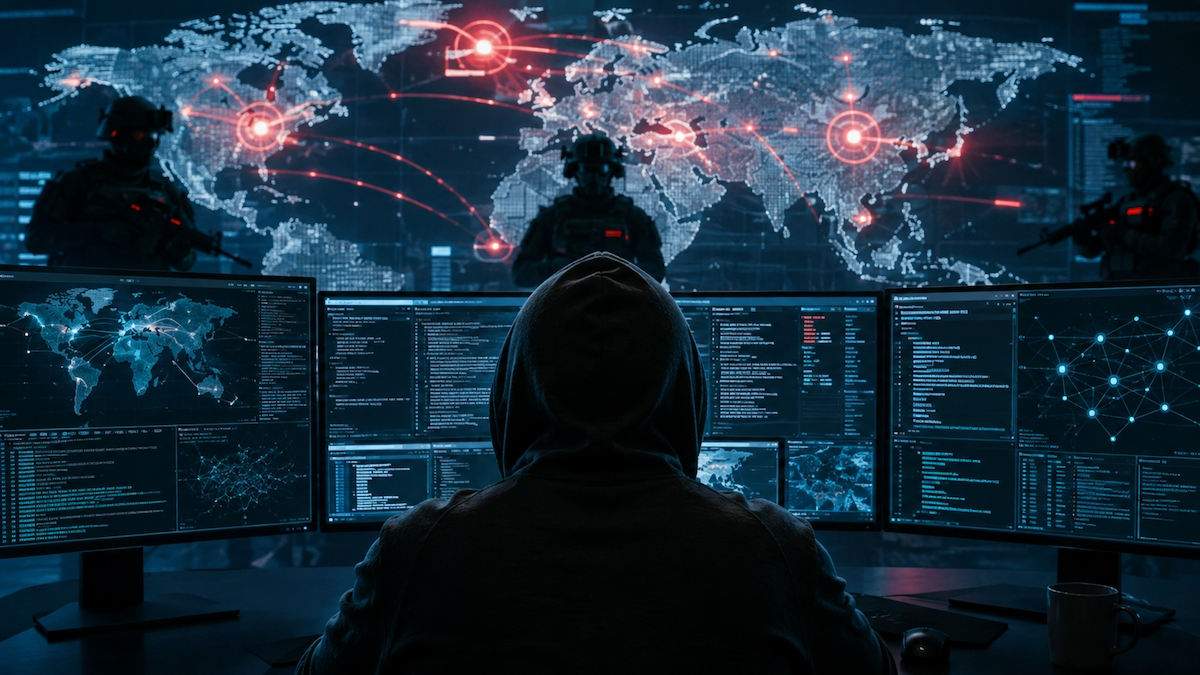
Let’s explore what cyberwarfare actually means, how it unfolds, and why it keeps national security advisors awake at night—all without sliding into textbook dullness.
💻 What Exactly Is Cyberwarfare?
Cyberwarfare is the use of digital attacks by one nation-state (or a state-sponsored group) to disrupt, damage, or destroy another nation’s computers, networks, or information systems. The objective isn’t petty theft—it’s strategic advantage, coercion, espionage, or outright sabotage.
Think of it as conflict conducted through packets and protocols rather than bullets and bombs. The targets can be:
- Military systems and command-and-control networks
- Critical national infrastructure (power grids, water supplies, transport)
- Government agencies and election systems
- Economic assets like banks, stock exchanges, or intellectual property
- Media outlets to manipulate public opinion
A key quirk of cyberwarfare: it often thrives in the grey zone—that ambiguous space below the threshold of traditional armed conflict. A power outage might look accidental, an information leak might seem like hacktivism, but behind the curtain, a military intelligence unit could be pulling the strings. This deniability makes it a devilishly attractive tool.
⚔️ The Arsenal: Common Tactics in Cyberwarfare
Over the years, I’ve seen the playbook evolve, but some classics remain alarmingly effective. Here’s what typically shows up in a state-level operation:
- Espionage and data exfiltration 🕵️: stealing classified military plans, diplomatic cables, or trade secrets. Advanced Persistent Threats (APTs) can lurk inside networks for months, quietly siphoning sensitive data.
- Sabotage and destructive malware 💣: code designed to physically damage equipment or wipe data. Not just crashing a server, but causing centrifuges to spin out of control or safety systems to fail.
- Disinformation and influence operations 📢: coordinated fake social media accounts, leaked forged documents, or manipulated videos to sow discord, swing elections, or discredit leaders.
- Denial-of-service (DoS) and ransomware attacks 🚫: flooding government websites to silence them during a crisis, or encrypting hospital systems to pressure a country. When tied to geopolitical demands, this stops being ordinary cybercrime.
- Supply chain compromise 🔗: sneaking backdoors into widely used software or hardware so that when a target nation installs it, the attacker walks right in. This is the “Trojan horse” of the digital age.
I’ve personally watched incident response teams chase shadows for weeks, only to discover the attackers came through a compromised software update that everyone trusted implicitly. It’s humbling.
🌐 Real-World Echoes: Not Just Hollywood Plots
You’ve likely heard fragments of these stories, but together they paint a vivid picture of cyberwarfare in action.
Ukraine Power Grid Attacks (2015 & 2016)
Hackers aligned with Russian military intelligence took down portions of Ukraine’s electricity grid in the dead of winter. They didn’t just flip a switch remotely; they overwrote firmware on substation equipment to make restoration harder, and flooded call centres with fake phone calls to delay reports from real customers. I recall the cybersecurity community’s collective shudder—this was the first confirmed instance of a cyberattack causing a blackout. The attack blended network intrusion, malware (BlackEnergy and Industroyer), and psychological operations seamlessly.
Stuxnet (Discovered 2010)
A masterclass in precision sabotage. Stuxnet was malware allegedly developed by the US and Israel to target Iran’s nuclear enrichment centrifuges. It spread via USB drives, sought out specific Siemens industrial controllers, and then subtly altered the speed of the centrifuges while feeding back normal readings to the operators. Physical damage occurred while engineers saw only green lights. This shifted cyberwarfare from theory into undeniable reality.
These examples aren’t ancient history—they’re blueprints. Today, we see states probing each other’s water treatment plants and electoral systems with similar techniques, just more refined.
🧩 Where Does This Leave Us?
For those of us defending networks, cyberwarfare blurs the lines between criminal, espionage, and military domains. An intrusion might start as a financially motivated ransomware gang, but that gang could be a state proxy washing its hands. We can’t always know who’s behind the keyboard, so we must defend against the most capable adversary by default. That means assuming your critical systems are being targeted by a nation-state with unlimited patience and resources.
The consequences of getting it wrong? Lives can be at stake when hospitals lose power, when water treatment fails, or when a country’s defence grid is blinded. It’s a sobering responsibility, but also a fascinating puzzle that keeps brilliant minds engaged.
🔑 Key Points
- Cyberwarfare is nation-state-driven digital conflict aimed at strategic disruption, espionage, or physical damage.
- Common tactics include espionage, sabotage, disinformation, supply chain compromise, and large-scale denial-of-service.
- The grey zone offers attackers plausible deniability, making attribution challenging.
- Real-world incidents like the Ukraine power grid attacks and Stuxnet prove that digital actions can cause tangible, physical consequences.
- Defenders must prepare for advanced persistent threats that may lurk undetected for months, often entering through trusted channels.
🧠 Test Your Knowledge
Let’s see if you can apply what you’ve just read. Don’t worry, no nation-state will probe your network if you miss one.