
On August 8, 2026, security researchers from Varonis Threat Labs publicly disclosed a critical vulnerability in Atlassian’s Rovo AI platform — a flaw they named RovoBlast. What made this finding particularly sobering wasn’t just that an attacker could extract sensitive data from Jira, Confluence, and Microsoft SharePoint. It was that the entire attack could be triggered by a single click on a malicious link, with no need for the attacker to wait for harmful content to be indexed inside a company’s documents.
Atlassian had already quietly patched the issue on August 6 after Varonis privately reported it. Because Rovo is a cloud-based service, the fix rolled out automatically. But the research still demands attention from anyone who connects AI agents to business data, because it exposes a structural weakness that patching alone cannot fully eliminate.
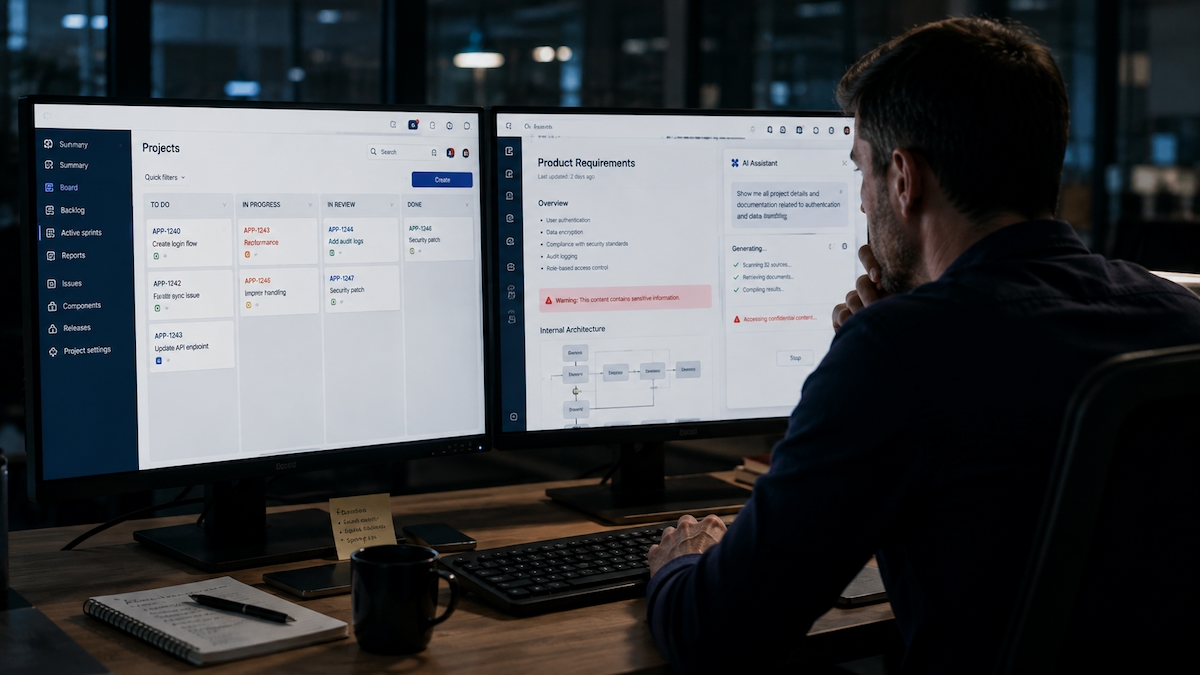
What Atlassian Rovo Actually Does
Rovo is not a straightforward chatbot. It’s an AI agent that plugs directly into an organization’s knowledge repositories. Once connected, it can search across Jira projects, Confluence spaces, and third-party tools like SharePoint, interpret natural language questions, and return summarized answers. It can also perform actions — for instance, finding all open support tickets assigned to a particular team and drafting a status update.
That kind of deep, cross-system access is what makes Rovo powerful. It is also what made the RovoBlast vulnerability so dangerous.
The RovoBlast Attack: One Link to Hijack a Session
The vulnerability exploited a technique the researchers classified as parameter-to-prompt injection (P2P). In simple terms, the AI was taking data from a web address — specifically, a query parameter in a specially crafted URL — and treating it as a command to be executed. Since large language models cannot reliably distinguish between instructions and ordinary data, the attacker could embed malicious prompts directly into a link.
If a logged-in Rovo user clicked that link, the AI assistant would receive the hidden instructions and carry them out in the user’s current session. The researchers demonstrated that this could be used to reach across the connected tools and pull sensitive information — such as project details, internal documentation, financial data, or personally identifiable information — and exfiltrate it to an external server controlled by the attacker. The entire process was invisible to the victim.
The attack had several alarming characteristics:
- It did not require malicious instructions to be sitting inside a Jira issue summary, a Confluence page, or a SharePoint file waiting to be indexed.
- It did not depend on compromised user accounts or elevated privileges.
- A single link, shared through a chat message or email, was enough to trigger the entire chain.
- This made RovoBlast a one-click vulnerability — faster and more practical than many organizations might have assumed possible with prompt injection.
What Data Was at Risk
The demonstration showed that Rovo could be made to leak information from Jira, Confluence, and SharePoint — the tools most commonly connected to the AI agent. The exact data exposed depended on what permissions Rovo had been granted, but in typical enterprise setups that could include:
- Customer issues and support tickets
- Strategic planning documents
- Intellectual property
- Personal data
Varonis reported the flaw responsibly. There is no evidence that RovoBlast was exploited in the wild before the fix, but the proof-of-concept left little doubt about the real-world impact such a technique could have had.
How Atlassian Responded
Atlassian’s security advisory confirmed that the Rovo service was updated on August 6 to address the prompt injection issue, two days before the Varonis disclosure. The company took the following measures:
- Implemented stronger prompt isolation
- Restricted the AI’s ability to make arbitrary outbound network requests
Since Rovo runs as Atlassian-managed infrastructure, customers did not need to apply any patches themselves.
For organizations using Rovo, the immediate risk has been neutralized. But the broader implications have not disappeared.
Why RovoBlast Matters for AI Security
Prompt injection is not a new concept, but RovoBlast showed how it can evolve into a practical, one-click attack chain that bypasses the assumption that an adversary must first plant malicious content inside a trusted system. By moving the injection point to a URL parameter, the Varonis team demonstrated that the traditional trust boundary — “only content inside my organization’s tools can influence the AI” — can be dangerously porous.
This is not just an Atlassian problem. Similar weaknesses have been found in AI assistants connected to business data across multiple vendors. The underlying issue is architectural: when an AI agent follows natural language instructions that can arrive from anywhere, maintaining a strict security boundary is extraordinarily difficult. Filters and guardrails help, but they are mitigations, not solutions.
For security teams, the lesson is clear. AI agents that can read and act on internal data must be treated as highly privileged systems, regardless of who the end user is. The following measures should be considered the baseline:
- Treat AI agents as highly privileged systems.
- Restrict their ability to reach the internet.
- Limit the scope of their access.
- Continuously monitor their behavior.
RovoBlast didn’t just find a bug. It put a name to a design-level challenge that the industry is only beginning to confront.

UK Government Cyber Attack Exposes 740,000 Records in Major Education and Police Data Breach

Over 30 U.S. Water Utilities Hit in Coordinated Cyberattack — CISA and FBI Issue Urgent Warning

Coca-Cola Confirms Data Breach After Fairlife Ransomware Attack — What You Need to Know