
📚 The Impact of Cyberattacks on Organisations
I’ve lost count of the number of times a business owner has told me, “We’re too small to be a target.” That sentence alone tells me they’re thinking about cyberattacks the wrong way. It’s not about who you are; it’s about what the attacker can get—money, data, a backdoor into a bigger partner, or simply the satisfaction of watching your operations grind to a halt. The impact lands in ways most leaders don’t anticipate until it’s happening to them, and when it does, it rarely stays inside the IT department.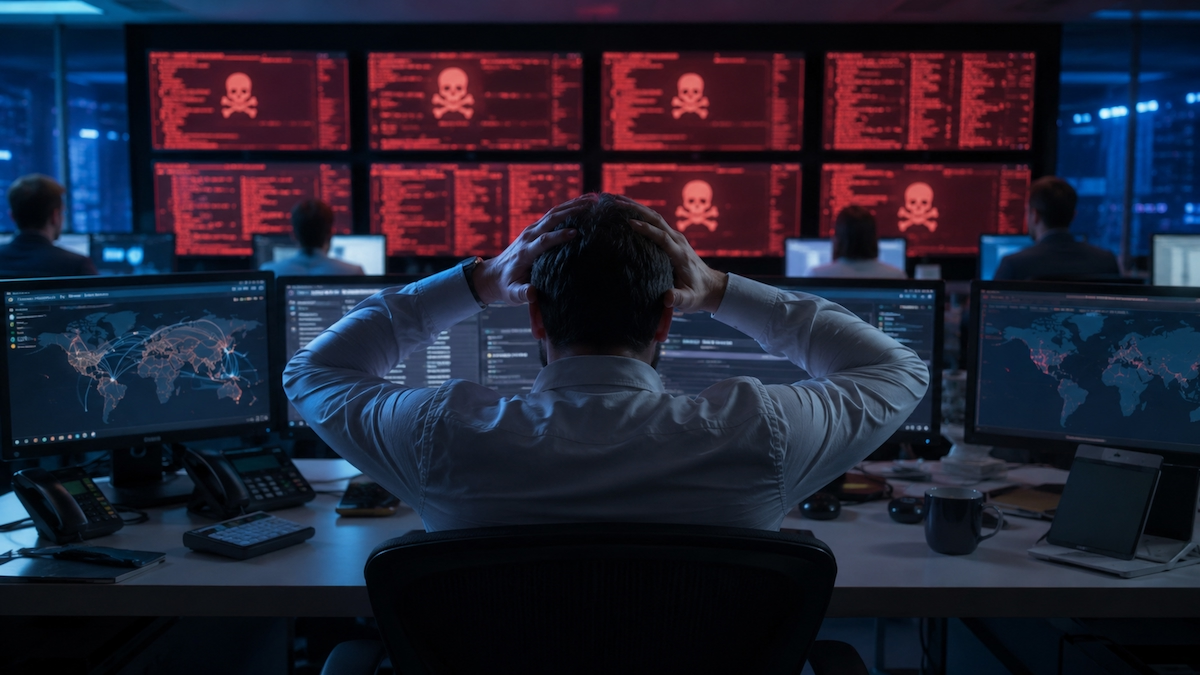
🔍 What Does ‘Impact’ Really Mean Here?
When we talk about the impact of a cyberattack on an organisation, we’re not just talking about the moment a system gets locked or data gets stolen. Impact is the full shockwave—the immediate damage, the knock-on effects that unfold over weeks and months, and the long-term scars that can change the entire trajectory of a business. It’s measured in pounds lost, trust evaporated, legal headaches, and human exhaustion. And the bitter truth? Some of the most painful consequences are the ones you never see line‑itemed on a balance sheet.
💰 The Financial Fallout
Money is the most obvious victim, but the numbers are rarely simple.
Direct costs
Ransom payments (if paid), forensic investigators, legal counsel, crisis PR firms, call‑centre staff to handle affected customers, and overtime for your IT crew. For a mid‑sized firm, even a “small” incident can burn through £100,000 before you’ve finished your first coffee of the day.
Business interruption
When systems go dark, so does revenue. I’ve watched an e‑commerce company lose nearly half a million in sales over a single weekend because their payment gateway was held hostage.
Regulatory fines
Under UK GDPR, the ICO can fine up to £17.5 million or 4% of annual worldwide turnover, whichever is higher. I’ve seen smaller companies assume they’d fly under the radar, only to get a six‑figure penalty that nearly closed their doors.
Long‑term financial drag
Insurance premiums shoot up, future borrowing becomes more expensive, and you might even find that partners renegotiate contracts because they now see you as a supply‑chain risk.
Money drains away fast, but it’s often the easier thing to fix compared to what comes next.
🏚️ Reputational Damage (The Silent Killer)
A brand is a fragile thing. It takes years to build trust and one mediocre headline to shatter it. After a breach, customers don’t think about encryption standards—they think, “You couldn’t keep my data safe.”
- Customer churn – People vote with their feet. I spoke with a regional retailer that lost 15% of its loyalty programme members within three months of a breach notification. They never came back.
- Difficulty attracting new business – Procurement teams now routinely ask for security certifications. A public incident makes you radioactive in a competitive tender.
- Media and social media pile‑on – Even a small breach gets amplified. The narrative sticks; you become “the company that got hacked,” not “the company that makes great products.”
That reputational bruise can outlast the technical recovery by years, and I’ve yet to see a PR campaign that genuinely erases it.
⚙️ Operational Disruption
This is where the pain becomes physical. Cyberattacks don’t just steal data—they stop things from working.
- Production lines halted – I recall a manufacturer whose shop floor stopped dead because the ransomware locked the engineering workstations that controlled the CNC machines. Each hour of downtime cost them roughly £20,000 in missed orders.
- Logistics chaos – If your warehouse management system goes offline, lorries sit idle, perishable goods spoil, and delivery promises break.
- Staff locked out of essential tools – Email, calendars, shared drives, phone systems—suddenly a modern office becomes a room full of people staring at error messages. Even when backups exist, restoration is rarely instant. Days of lost productivity pile up quickly.
Operational disruption is rarely just an IT problem; it’s an entire‑company heart attack.
⚖️ Legal and Regulatory Consequences
When customer data is involved, lawyers get busy. The legal fallout can shadow an organisation for years.
- Regulatory investigations – In the UK, the ICO investigates serious breaches, and that process alone is draining—teams get pulled into endless evidence‑gathering, management meetings, and anxiety‑inducing phone calls.
- Class‑action lawsuits and compensation claims – The landmark case against a major British airline in 2018/19 showed that groups can band together to seek damages for distress, not just financial loss. Even if you win, the legal fees and distraction are punishing.
- Personal liability for directors – In extreme cases, directors can face individual scrutiny if negligence is found. Suddenly, the boardroom pays a lot more attention to cyber risk.
I’ve seen companies spend more on post‑breach legal fees than they ever did on defensive security measures beforehand. That stings.
🧠 The Human and Cultural Toll
We talk far too little about what a cyberattack does to the people inside the organisation.
- IT staff burnout – The people who have to pull all‑nighters to rebuild servers and comb through logs often carry invisible scars. I’ve seen promising engineers leave the industry entirely after a particularly traumatic incident.
- Blame culture – A breach can turn colleagues against each other. Was it the person who clicked the link? The manager who refused to fund multi‑factor authentication? That toxicity lingers.
- Loss of morale – Everyone feels violated. The company you were proud to work for suddenly feels vulnerable, and that collective confidence dip can kill innovation.
This human side is messy and rarely gets a line in the post‑mortem report, but it’s real.
📉 Long‑Term Strategic Setbacks
Beyond the crisis, the ripple effects can alter an organisation’s future.
- Postponed digital transformation – After a breach, boards get scared. Projects that would modernise the business (cloud migrations, new customer platforms) get delayed because trust in the IT environment evaporates.
- Talent acquisition struggles – Security‑conscious candidates think twice about joining a company with a recent incident. Hard‑to‑fill roles become even harder.
- M&A complications – I once advised on a deal where a mid‑market acquisition target had suffered a quiet breach. The buyer carved millions off the valuation. A cyber incident can become permanent baggage that devalues everything the founders built.
The worst part? You can’t plan your way out of some of these impacts. They simply eat away at the organisation’s future.
🗺️ Real‑World Example: Maersk and NotPetya (2017)
In June 2017, the shipping giant A.P. Moller‑Maersk was hit by the NotPetya malware, a destructive wiper disguised as ransomware. The attack didn’t just encrypt a few files—it bricked entire IT systems worldwide in minutes.
- Operational tsunami – 49,000 laptops and 4,000 servers were rendered useless. Port terminals from Los Angeles to Rotterdam went manual, meaning staff resorted to pen, paper, and walkie‑talkies to keep cargo moving. Shipments sat stranded.
- Financial shock – The company later disclosed a staggering hit of roughly $300 million (around £230 million at the time) in lost revenue, IT restoration, and business disruption. That was a single event, not a year of accumulated incidents.
- Recovery heroics – A lone domain controller in a remote Ghana office had survived because of a power outage. The IT team flew the machine back to headquarters as the foundation for rebuilding their entire Active Directory. It’s the sort of story that highlights how close organisations can come to total digital collapse.
- Long‑term outcome – Maersk survived and even strengthened its security posture, but the leadership team later admitted it took months of absolute chaos before any sense of normality returned. The incident became a global wake‑up call about how interconnected supply chains can act as attack amplifiers.
Maersk wasn’t even the intended target—NotPetya was aimed at Ukraine. The malware spread through legitimate accounting software and went global in hours. That’s the terrifying truth: impact doesn’t care about intent.
⭐ Key Points
- Cyberattack impact is multidimensional—it goes far beyond the immediate IT cleanup.
- Financial costs include direct response expenses, business interruption, regulatory fines, and long‑term insurance or borrowing penalties.
- Reputational harm often outlasts technical recovery, driving away customers and partners.
- Operational disruption can halt manufacturing, logistics, and day‑to‑day office work, costing thousands per hour.
- Legal and regulatory consequences may involve ICO investigations, lawsuits, and even director liability.
- Human toll on staff—burnout, blame culture, and loss of morale—is real but rarely quantified.
- Strategic setbacks such as delayed projects, hiring difficulties, and reduced company valuation can change an organisation’s future.
- The scale of impact is often disconnected from the attacker’s original target; an organisation can be collateral damage, as Maersk was.